
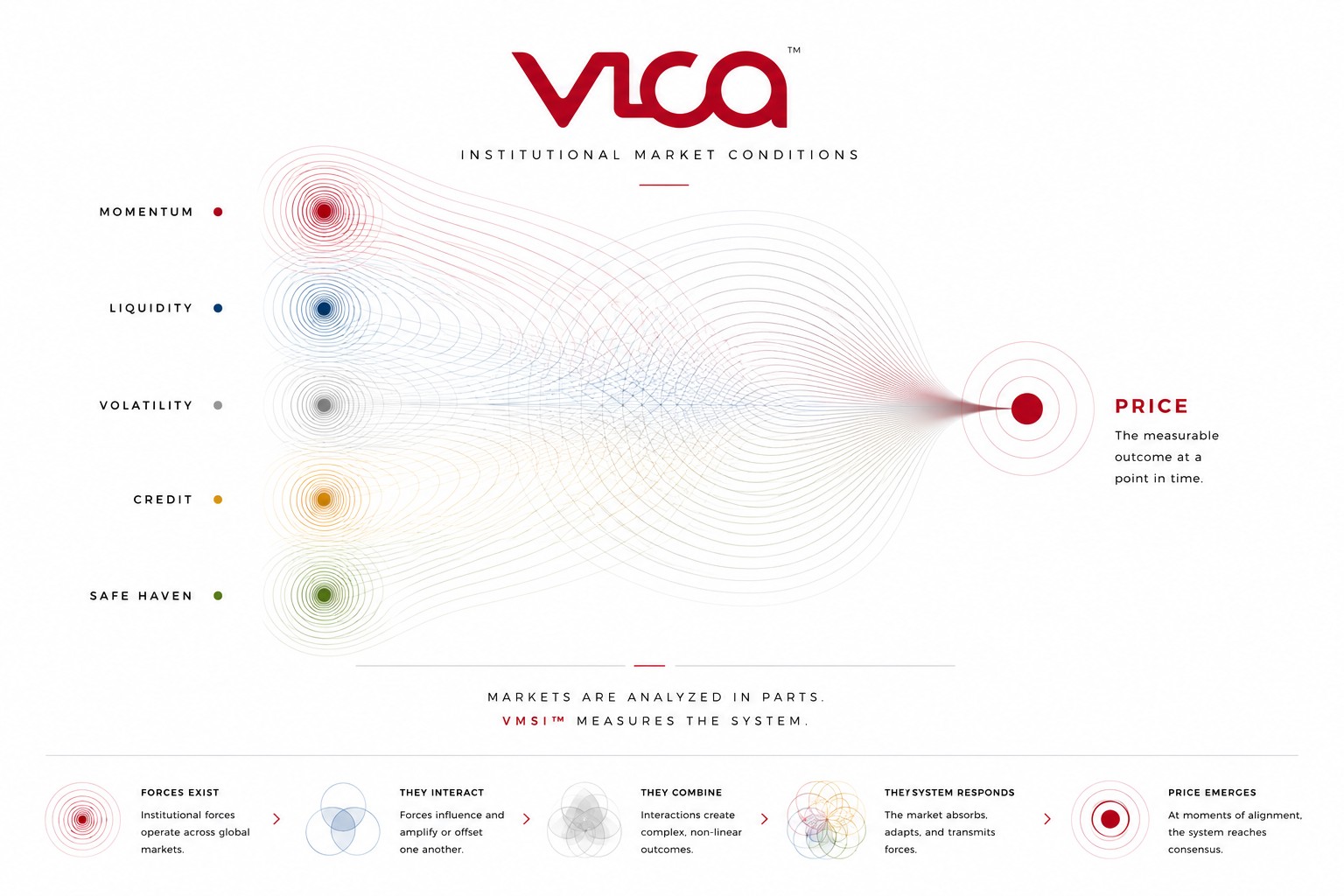
Capital moves first.
VICA Partners is an institutional market intelligence and research firm focused on market structure, capital flows, and systematic allocation.
We measure the institutional state beneath price—how capital is positioned, how that positioning persists, and how it transmits through markets.
VMSI™ is designed to capture institutional capital inertia and the relationships among participation, liquidity, credit, volatility, positioning, capital deployment, and global markets.
In the tested sample, adding VMSI™ reduced aggregate out-of-sample forecast error relative to a conventional institutional signal set.
Conventional analysis measures conditions in parts. VMSI™ measures their organization.
VMSI™ Framework

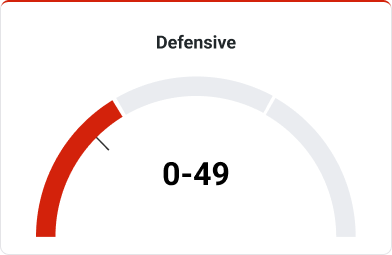
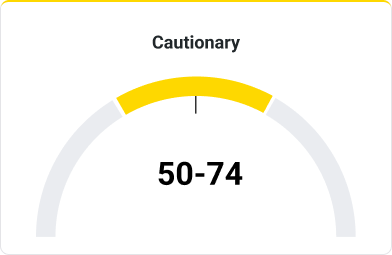
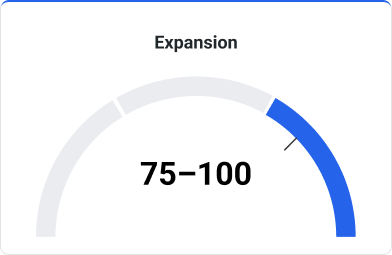
The VMSI™ Regimes
Four forces. One integrated measure of institutional state.
Critical: 0–25 · Defensive: 26–49 · Cautionary: 50–74 · Expansion: 75–100.
Why VMSI™ Matters

The Institutional Advantage
VMSI™ adds information conventional market signals can leave unobserved.
Large institutional investors already measure rates, volatility, credit, liquidity, breadth, momentum, and macro conditions. VMSI™ adds a different variable: the organization and persistence of institutional capital across those conditions.
The distinction is state. VMSI™ identifies whether capital positioning is reinforcing, weakening, or transmitting through the system—and whether that structure is likely to persist as individual market conditions change.
Detect State Transitions
Identify changes in institutional organization that may not yet be apparent in price or any single conventional indicator.
Measure Capital Inertia
Distinguish transient market movement from embedded institutional positioning that continues to influence subsequent market behavior.
Strengthen Existing Models
Integrate VMSI™ as an independent state variable within allocation, risk, portfolio construction, regime identification, and systematic research.
The empirical evidence supports the distinction. Even after current VMSI™ and conventional signals were known, prior VMSI™ state improved out-of-sample results in 64.3% of observations and reduced total squared error by 7.2%—evidence consistent with persistent institutional Capital Inertia.
Conventional signals measure conditions. VMSI™ adds information about the institutional state connecting them.
From Measurement to Validation
VICA’s research process connects institutional market-state measurement with system relationships, capital behavior, forward testing, falsification, and a defined path to institutional validation.
Market State → System Relationships → Capital Behavior → Forward Testing → Falsification → Institutional Validation

Built for Institutional Capital
A differentiated market-state layer designed to improve institutional decision quality.
VMSI™ adds incremental information about capital persistence, transmission, and regime structure that conventional institutional signal sets may not fully capture.
For large asset managers, that additional information can strengthen capital allocation, risk control, portfolio construction, regime identification, and systematic research—without replacing existing models.
Independent. Systematic. Falsifiable.
The institutional value is straightforward: better state recognition can support earlier risk identification, more disciplined capital allocation, and a differentiated research capability across investment teams and products.
For institutions that already have the data, VMSI™ is designed to extract information the existing stack may not see.
Institutional Research & Evaluation
VICA welcomes independent institutional evaluation of VMSI™ and discussions regarding research, validation, and potential applications.