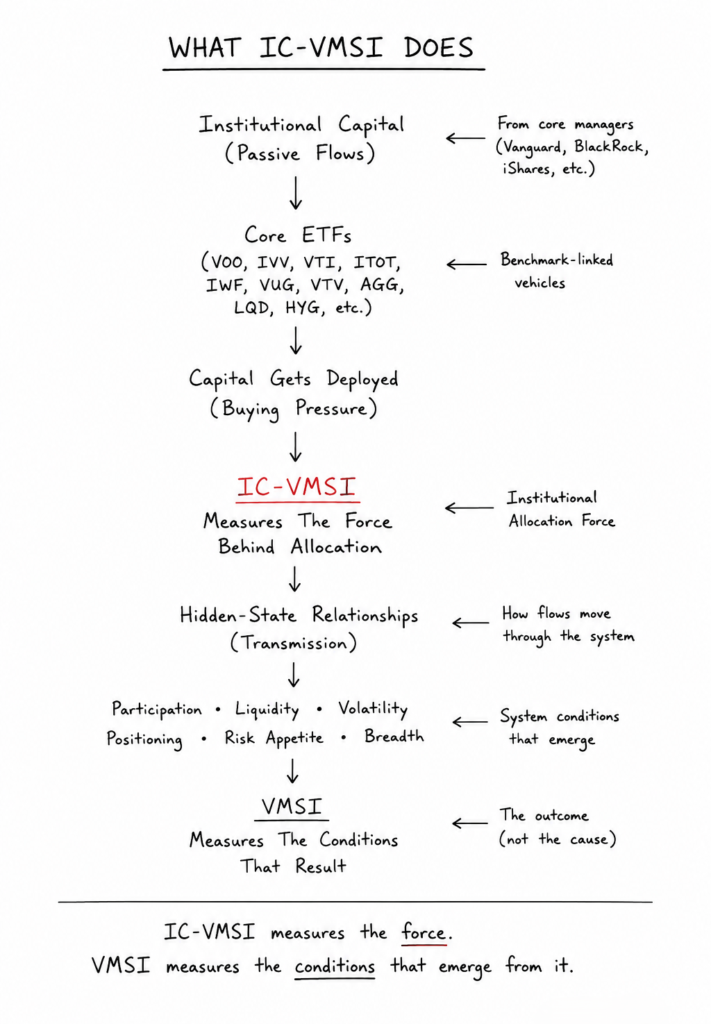
They measure prices, valuations, earnings, economic activity, volatility, and investor behavior.
These variables describe what happened.
They do not directly measure the source of capital entering the system.
This distinction has become more important as passive and benchmark-linked investment structures have grown as a share of market participation.
A growing portion of market demand now originates from index funds, retirement plans, target-date funds, model portfolios, and benchmark-linked mandates.
These structures allocate capital according to rules.
As a result, market conditions and capital allocation are no longer equivalent observations.
A market may strengthen because conditions improve.
A market may also strengthen because benchmark-linked capital continues to enter the system.
Most frameworks measure the first.
IC-VMSI measures the second.
IC-VMSI measures institutional allocation force. VMSI measures the conditions that emerge from it.
Definition
The Institutional Core Buys Index (IC-VMSI™) measures institutional capital deployment through passive and benchmark-linked investment structures.
The framework estimates the direction, magnitude, and persistence of benchmark-linked allocation across core equity, fixed income, and international investment vehicles.
IC-VMSI does not measure sentiment, valuation, forecasts, or opinion.
It measures observable capital deployment.
Conditions and Forces
A distinction exists between conditions and forces.
Conditions describe the state of a system.
Forces describe the mechanisms acting upon that system.
Most market frameworks measure conditions.
IC-VMSI measures force.
The central question is not:
What is the market doing?
The central question is:
Who is supplying the capital behind what the market is doing?
Why IC-VMSI Exists
Traditional market models were developed when active security selection represented the dominant mechanism of capital allocation.
That structure has changed.
Today, a significant share of capital is deployed through benchmark-linked allocation systems governed by fund flows, contribution schedules, rebalancing processes, and index construction rules.
These flows can influence market structure independently of valuation changes, earnings revisions, economic forecasts, or investor opinion.
IC-VMSI was developed to measure that force directly.
Advanced Signal Layer Integration
Within the VICA Institutional Market Sentiment Index (VMSI™), IC-VMSI functions as part of the Advanced Signal Layer alongside SPI, CMX, PDCS, and GFP.
Periodic Candidate Review VICA Research periodically applies IC-VMSI™ to companies exhibiting unusually strong preliminary evidence of institutional capital force. Candidates...
Periodic Candidate Review VICA Research periodically applies IC-VMSI™ to companies exhibiting unusually strong preliminary evidence of institutional capital force. Candidates...