Institutional Coordination Improved. Conviction Remained Selective.
June 29, 2026
Matthew Krumholz
Week Ending June 26, 2026
Institutional market conditions improved as participation broadened, credit remained orderly, and capital deployment continued across core allocation channels. Conviction remained selective as hedging, sector leadership, and global participation did not confirm a fully synchronized expansion.
Live Report: vicapartners.com
VMSI™ Framework
Framework
Score
State
VMSI Composite
64.0
Institutional conditions improved modestly as participation broadened beneath headline weakness, but conviction remained uneven.
Momentum
68.9
Equal-weight, value, Dow, and Russell participation offset mega-cap growth weakness, improving transmission without full synchronization.
Liquidity
61.9
Fed liquidity was stable and credit markets remained orderly, though modest high-yield spread widening limited the upgrade.
Volatility & Hedging
59.8
Protection demand remained active and dealer gamma was negative, but VVIX, MOVE, and credit did not confirm systemic stress.
Safe Haven Demand
48.8
Defensive assets lost relative leadership as gold weakened and Treasury demand appeared orderly rather than crisis-driven.
Advanced Signal Layer
Framework
Score
State
SPI
67.2
Participation broadened materially across breadth, equal weight, value, and small-cap leadership, though technology weakness kept confirmation incomplete.
CMX
58.8
Convexity remained functional but less supportive; negative dealer gamma and active put demand offset subdued VVIX and MOVE conditions.
PDCS
71.0
Deployment remained strong across broad equity and fixed-income ETF channels, but capital preference stayed selective rather than fully risk-on.
GFP
65.8
Global participation remained constructive in aggregate, but China weakness, international pullbacks, and dollar firmness limited synchronization.
PLMT
Selective Synchronization Expansion
Participation expanded across more domestic channels, but technology and China divergence prevented a broad participation classification.
IC-VMSI
69.0
Core institutional buying remained deployed through broad beta, value, and bond channels while sector and regional conviction stayed selective.
Executive Summary
The VMSI™ Composite increased to 64.0 from 63.5, reflecting another week of improving institutional market conditions. Momentum registered 68.9, Liquidity improved to 61.9, and Volatility & Hedging stood at 59.8, indicating the composite improvement was supported by participation and liquidity rather than a single risk-on impulse.
Participation continued expanding across multiple market measures, while credit conditions remained supportive and institutional capital deployment stayed constructive. SPI improved to 67.2, PDCS remained elevated at 71.0, and IC-VMSI held at 69.0, indicating stronger coordination across market structure, capital deployment, and benchmark-linked allocation.
The improvement remained selective rather than broad-based. Safe Haven Demand declined to 48.8, while CMX fell to 58.8 after dealer gamma validation confirmed less supportive convexity conditions. Hedging demand remained active, and institutional conviction expanded more slowly than overall market coordination.
Taken together, independent measures of market structure, liquidity, credit conditions, positioning, and institutional deployment supported the same conclusion. The market became more coordinated, but selective conviction remained the primary constraint on a fully synchronized expansion.
Key Takeaway: Independent institutional measures continued strengthening together, but conviction remained more selective than overall market coordination.
Market Structure
Institutional participation broadened despite continued selectivity beneath the surface. The Participation Integrity Ratio (PIR™ = RSP ÷ SPY) remained consistent with expanding market participation, indicating equal-weight stocks continued supporting capitalization-weighted index performance rather than leadership becoming more concentrated.
Market breadth remained constructive across multiple sectors and market capitalizations. The S&P 500 declined roughly 1.95% for the week, while the Nasdaq fell more sharply and the Russell 2000 remained constructive, showing that headline index weakness did not fully capture internal participation.
Leadership, however, remained selective. Growth leadership moderated while value and broader market participation continued providing support, producing a stronger internal market structure than index performance alone suggested.
Taken together, PIR™, improving breadth, and broader participation indicate institutional coordination continued strengthening even as conviction remained selective.
Structural conclusion: Participation broadened faster than conviction.
Credit & Liquidity Conditions
Credit conditions remained orderly as institutional funding markets continued functioning without evidence of systemic stress. The Credit Quality Ratio (CQR™ = LQD ÷ HYG) remained stable, while both investment-grade and high-yield credit continued trading within contained ranges despite modest week-to-week divergence.
Investment-grade credit continued showing stronger sponsorship than high yield. LQD closed at 109.50 while HYG finished at 79.83, producing a CQR™ of 1.372, indicating institutional preference continued favoring higher-quality credit without a broad withdrawal from corporate credit markets.
Credit spread acceleration remained contained. HY OAS widened roughly 12 bps, while IG OAS widened roughly 2 bps, suggesting recent market volatility reflected tactical repositioning rather than a deterioration in underlying credit quality or funding availability.
Taken together, stable CQR™, contained spread acceleration, and orderly corporate credit trading indicate liquidity conditions continued supporting broader institutional market coordination.
Structural conclusion: Credit quality remained stronger than risk appetite.
Positioning & Convexity
Institutional positioning continued normalizing as hedging activity remained orderly rather than defensive. The Hedging Preference Ratio (HPR™ = CPCE ÷ CPCI) stood near 0.71, indicating portfolio-level hedging continued exceeding single-stock hedging without signaling broad market stress.
Dealer positioning remained less supportive than a fully stabilized convexity regime. Negative gamma limited the improvement in CMX, even as VIX, VVIX, MOVE, and credit conditions did not confirm systemic volatility stress.
ETF flow data confirmed this behavior. Net equity allocations remained constructive while bond allocations continued stabilizing, indicating institutions continued reallocating capital within portfolios rather than materially reducing overall market exposure.
Taken together, HPR™, contained volatility-of-volatility, and constructive ETF flows indicate institutions continued managing risk through selective positioning rather than broad de-risking.
Structural conclusion: Institutional positioning remained constructive as hedging became increasingly selective.
Flow & Allocation Behavior
Institutional capital continued deploying across markets despite selective leadership and ongoing sector rotation. The Deployment Force Ratio (DFR™ = Equity ETF Flows ÷ Bond ETF Flows) indicated that observed ETF allocations continued favoring equity exposure relative to fixed income.
Rather than evaluating equity and bond flows independently, DFR™ transforms those observations into information about allocation preference. Equity ETF flows of roughly $36.37B and bond ETF flows of roughly $10.08B imply a DFR™ near 3.6, indicating capital deployment favored risk assets without eliminating bond demand.
This week’s allocation patterns remained consistent with constructive institutional positioning. Core benchmark-linked equity funds continued attracting capital while bond allocations remained supportive but secondary, indicating portfolio reallocation rather than broad defensive repositioning.
Taken together, DFR™, IC-VMSI™, and ETF flow behavior indicate institutional capital continued expanding into risk assets even as conviction remained selective across sectors and regions.
Structural conclusion: Capital deployment favored risk assets without eliminating portfolio balance.
Global Propagation Conditions
Global propagation remained constructive but uneven across regions. The Global Propagation Ratio (GPR™ = VEA ÷ VWO) remained consistent with stronger institutional sponsorship of developed markets, indicating global participation continued broadening selectively rather than uniformly.
Rather than evaluating international markets independently, GPR™ transforms regional performance into information about institutional capital propagation. Developed market participation remained more resilient than emerging markets, while China continued lagging broader global equity participation.
Supporting market evidence reinforced this interpretation. VEA closed at 70.56 and VWO at 58.58, producing a GPR™ near 1.20, while EEM, EWJ, FXI, DXY, and GLD continued showing uneven global transmission.
Taken together, GPR™, IC-VMSI™, and global allocation behavior indicate institutional capital continued propagating across the global system while maintaining a preference for developed-market quality and selective regional deployment.
Structural conclusion: Global participation remained constructive, but institutional deployment stayed selective.
Advanced Signal Layer
Independent structural measures continued converging on the same institutional conclusion. SPI, CMX, PDCS, GFP, and IC-VMSI each measured different dimensions of market behavior, yet collectively identified improving institutional coordination without evidence of fully synchronized market conviction.
Rather than evaluating these measures independently, the Advanced Signal Layer applies a structured process grounded in information relationships, pattern recognition, hidden-state estimation, and independent signal confirmation. Each framework contributes unique information about market structure, while their convergence increases confidence that observed institutional conditions represent genuine system behavior rather than short-term market noise.
This week’s evidence remained internally consistent. SPI confirmed improving participation integrity, CMX indicated functional but incomplete convexity conditions, PDCS confirmed continued benchmark-linked capital deployment, GFP supported selective global propagation, and IC-VMSI reinforced continued institutional capital deployment.
Taken together, the Advanced Signal Layer indicates that improving institutional coordination is supported by multiple independent sources of evidence rather than any single market indicator.
Structural conclusion: Independent structural signals converged on the same institutional outcome, increasing confidence that the current regime reflects genuine market organization rather than temporary market noise.
Structural Discoveries
1. Institutional coordination improved faster than conviction. Participation and capital deployment strengthened while institutional risk management remained selective.
2. Credit continued validating capital deployment. Credit quality remained supportive, confirming expanding institutional allocation without evidence of systemic deterioration.
3. Independent structural signals converged on the same regime. The Advanced Signal Layer independently confirmed improving institutional coordination across participation, credit, positioning, deployment, and global propagation.
Structural Assessment: Independent information relationships and structural validation frameworks converged on the same institutional regime with high confidence.
Final Institutional Assessment
The independent evidence presented throughout this report converged on the same institutional conclusion. Participation broadened, credit conditions remained supportive, capital deployment continued expanding, and global propagation remained constructive but uneven, while institutional conviction remained selective rather than fully synchronized.
The VMSI framework reached this conclusion through a structured sequence of observation, information extraction, pattern recognition, hidden-state estimation, and independent signal confirmation. Proprietary relationship metrics (PIR™, CQR™, HPR™, DFR™, and GPR™) transformed observable market conditions into institutional information, while the Advanced Signal Layer independently validated the resulting structural assessment.
Collectively, the evidence indicates that institutional market organization continued improving without evidence of systemic deterioration. The current environment reflects expanding coordination supported by orderly liquidity, constructive credit conditions, disciplined capital deployment, and selective institutional risk management.
Regime Assessment: The institutional market regime remains Selective Synchronization Expansion, characterized by improving system organization, constructive capital deployment, and selective institutional conviction.
About the VICA Institutional Market Sentiment Index (VMSI™)
The VICA Institutional Market Sentiment Index (VMSI™) is an observational market framework that measures the institutional conditions shaping market behavior before those conditions become fully reflected in prices.
Rather than analyzing individual indicators in isolation, VMSI measures the relationships among participation, liquidity, credit, positioning, capital deployment, and global propagation to identify the underlying organization of institutional markets.
Each weekly publication integrates observable market data, proprietary relationship metrics, and independent structural validation to estimate the current institutional market regime.
IC-VMSI™ (Institutional Capital VMSI) measures institutional capital deployment through ownership, allocation, portfolio positioning, and benchmark-linked investment behavior. The framework estimates institutional capital deployment across markets using observable evidence rather than individual trade reporting.
Disclaimer
VMSI™ is a proprietary observational market framework developed by VICA Research. This publication is provided for informational purposes only and does not constitute investment advice or a recommendation to buy or sell any security. Conclusions reflect evidence-based interpretations of available market information at the time of publication and may change as new evidence becomes available.
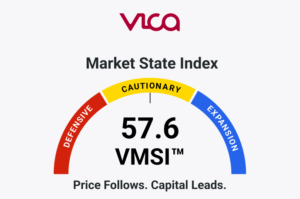
Participation Repaired. Credit Dispersion Persisted. The VMSI™ Composite increased to 57.6, with IC-VMSI™ at 64.9 and the Institutional Capital Migration...
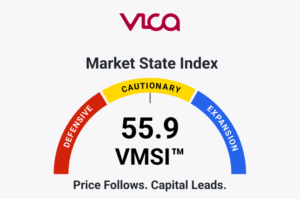
Price Held. Institutional Support Weakened. The VMSI™ Composite declined to 55.9. Headline equity performance remained comparatively resilient, but participation weakened,...