Financial markets continue to evaluate geopolitical instability through an increasingly outdated framework. Most institutional models remain event-based: conflict emerges, markets react, equilibrium returns. Current market structure no longer behaves this way.
The dominant variable in modern geopolitical regimes is not the appearance of instability itself, but the persistence of unresolved instability over time.
This distinction matters because markets rarely fail at the initial appearance of pressure. They fail after prolonged pressure alters the structural behavior of the system itself.
To address this gap, VICA Research developed the Geopolitical Friction Premium (GFP), a proprietary VMSI sub-metric designed to measure accumulated geopolitical pressure and its impact on market sensitivity, volatility structure, liquidity behavior, and convex risk formation.
The objective of GFP is not to predict headlines. The objective is to identify when persistent instability begins changing market flexibility, positioning behavior, volatility response functions, and the probability distribution of future outcomes.
I. The Structural Misclassification of Risk
Traditional geopolitical frameworks assume that markets process instability linearly. Under this assumption, new information produces proportional reactions, volatility remains episodic, and equilibrium eventually re-establishes itself through price discovery.
This framework increasingly fails under persistent-friction environments.
Modern geopolitical conditions are defined by unresolved strategic competition, prolonged instability without resolution, controlled escalation, and continuous system-level stress across energy, trade, liquidity, and capital flows.
Under these conditions, markets do not immediately express instability through directional collapse. Instead, pressure accumulates beneath stable price behavior.
This distinction between visible stability and underlying sensitivity forms the conceptual basis of GFP.
II. The Function of GFP
The Geopolitical Friction Premium was developed to measure the cumulative effect of unresolved geopolitical pressure on market structure over time.
Unlike traditional volatility frameworks that primarily measure reaction, GFP measures accumulation.
The framework evaluates escalation intensity, persistence of instability, exposure of critical systems, probability of resolution, and resulting changes in market sensitivity.
The central premise is straightforward: markets do not generally become unstable because risk appears. Markets become unstable because persistent pressure gradually reduces the system’s ability to absorb additional stress efficiently.
In practical terms, GFP measures the transition from flexible markets to constrained markets and ultimately toward convex markets.
This phase is best understood as compression: pressure accumulates internally while price behavior remains superficially stable.
Over time, however, structural conditions begin changing. Leadership narrows, positioning concentrates, volatility baselines rise, and trend persistence deteriorates. The market gradually loses flexibility.
At sufficiently elevated GFP conditions, the response function of the market itself changes. Incremental developments begin generating disproportionately large reactions across volatility, liquidity, correlations, and positioning behavior.
This is the transition into convex risk.
Convexity is not simply elevated volatility. Convexity reflects a condition in which system sensitivity accelerates, nonlinear outcomes become increasingly probable, and market reactions become disproportionately large relative to initiating events.
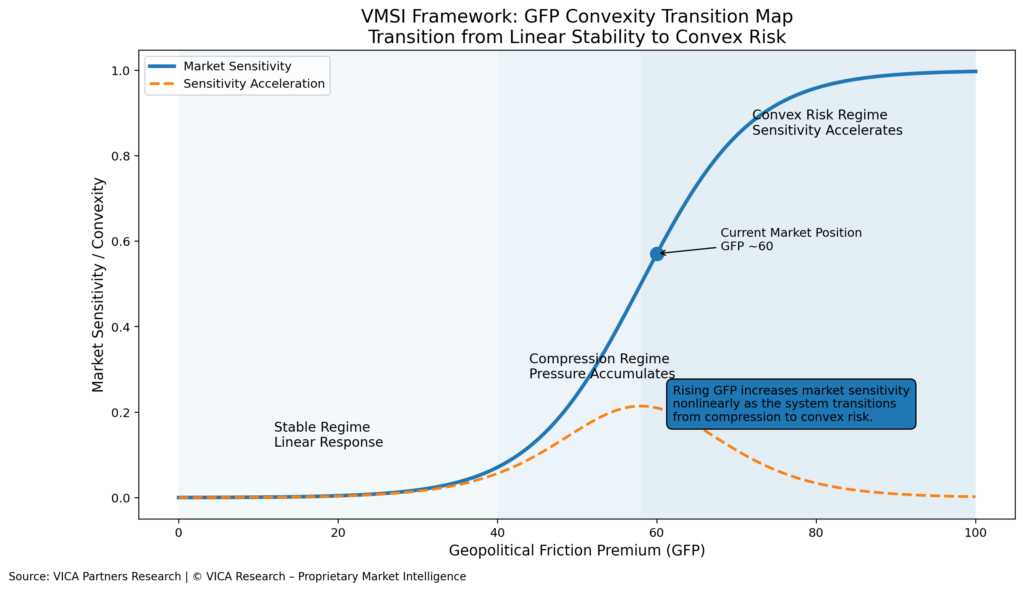
Persistent geopolitical pressure does not initially produce nonlinear market behavior. Early-stage instability is often absorbed efficiently through liquidity, positioning flexibility, and stable volatility conditions. Over time, however, persistent friction alters the market’s response function itself. The result is a transition from linear stability toward convex sensitivity, where increasingly small disturbances begin generating disproportionately large reactions across volatility, liquidity, and positioning behavior.
VMSI Framework: GFP Convexity Transition Map
Transition from Linear Stability to Convex Risk
Structural Interpretation
The GFP Convexity Transition Map illustrates how persistent geopolitical friction progressively alters market sensitivity. Under stable conditions, markets respond linearly to new information. Under elevated and persistent friction, however, the system transitions into a convex regime where sensitivity accelerates nonlinearly and volatility expansion becomes increasingly probable.
Current GFP conditions indicate the market is already operating near the convex transition zone. GFP is elevated and rising, signaling increasing probability of volatility expansion — positioning should shift as the market transitions from compression to convex risk.
IV. Current Market Structure
Current GFP conditions indicate elevated and rising geopolitical friction, increasing market sensitivity, and transition toward a convex risk regime.
At the surface level, the S&P 500 continues exhibiting apparent stability. Index-level price remains broadly range-bound, major dislocations remain limited, and broad liquidity conditions remain functional.
Internally, however, the market increasingly reflects late-stage compression dynamics. Leadership concentration remains elevated, breakout reliability continues weakening, sector rotation persists beneath stable index conditions, and volatility remains structurally firm despite limited directional movement.
This divergence is the signal.
Price stability should not automatically be interpreted as systemic stability.
In persistent-friction environments, stable price action often reflects delayed repricing, constrained liquidity behavior, and progressive pressure absorption throughout the system.
V. Structural Implications for Capital Positioning
GFP is not a directional forecasting model. It is a structural regime framework designed to identify when market flexibility is declining, sensitivity is accelerating, and asymmetry is increasing beneath stable price conditions.
Under elevated GFP conditions, volatility becomes structural rather than episodic, trend reliability deteriorates, false breakouts increase, and optionality becomes increasingly valuable.
As markets transition from compression toward convexity, timing windows narrow, positioning asymmetry rises, and incremental changes in external conditions carry amplified market consequences.
The practical implication is not immediate market failure. The implication is increasing structural fragility under persistent pressure.
Current GFP readings suggest the market is no longer operating within a traditionally stable regime. Instead, the system increasingly reflects elevated geopolitical friction, declining structural flexibility, and rising probability of nonlinear volatility expansion.
VI. Conclusion
Current conditions do not imply inevitability of immediate dislocation. They do imply that the probability distribution of future outcomes is changing materially.
Market sensitivity is increasing. Convexity conditions are strengthening. The system is becoming progressively less tolerant of incremental stress.
The central conclusion is therefore structural rather than directional:
GFP is elevated and rising, signaling increasing probability of volatility expansion — positioning should shift as the market transitions from compression to convex risk.
Markets rarely fail at the moment instability first appears. They fail after prolonged pressure changes positioning behavior, volatility response, liquidity flexibility, and the structural resilience of the system itself.
Current market conditions increasingly reflect that transition.
About the VICA Institutional Market Sentiment Index (VMSI)
The VICA Institutional Market Sentiment Index (VMSI) is a proprietary model that measures institutional risk posture across global markets.
It combines cross-asset inputs including momentum, liquidity, volatility structure, credit conditions, safe-haven demand, geopolitical friction, and institutional positioning behavior.
Scores are generated through a systematic framework using volatility regimes, credit spreads, liquidity conditions, macro signals, geopolitical pressure metrics, and capital flow analysis.
Index Scale
0–25: Critical Risk Zone 26–49: Defensive 50–74: Cautionary Optimism 75–100: Expansion / High Confidence
Disclaimer
This report is for informational purposes only and does not constitute investment advice or a recommendation. Views are based on current data and VICA Research models and are subject to change without notice. No guarantee is made as to accuracy or completeness. Past performance is not indicative of future results.
Important Notice
This report and the proprietary VICA Market Sentiment Index (VMSI), Geopolitical Friction Premium (GFP), Convexity Metrics Index (CMX), and Pre-Deployment Capital Signals (PDCS) are protected intellectual property of VICA Research. Unauthorized use, reproduction, redistribution, or commercial application is strictly prohibited.
VICA Research
Capital does not follow headlines. It follows structure.
Markets are governed by core capital.Priced by marginal capital.Most investors study price.IC-VMSI studies ownership, capital flows, and institutional force.