Why Modern Market Structure Increasingly Distorts Informational Purity
A Structural Reassessment of Reflexive Liquidity, Signal Integrity, and Adaptive Capital Systems
Executive Summary
Modern financial markets are increasingly interpreted through frameworks designed for a market structure that no longer fully exists.
Classical finance, CAPM, quantitative allocation systems, and most algorithmic frameworks were built during periods when price discovery remained more closely tied to productive economic expectations, broad participation, and stable relationships between volatility, liquidity, and risk.
That structure has changed.
Today’s markets increasingly operate through passive concentration, derivative-driven liquidity behavior, volatility suppression, reflexive positioning, and self-reinforcing allocation loops. As a result, many legacy frameworks remain mathematically sophisticated while becoming progressively less effective at identifying structural fragility beneath apparent stability.
At VICA Research, we define this transition as:
Post-Linear Market Theory
Modern markets increasingly behave not as equilibrium systems, but as adaptive behavioral liquidity systems where reflexive flows, concentration, and participation psychology increasingly shape price discovery itself.
The Structural Shift
Classical finance assumed that price broadly reflected information, volatility broadly reflected risk, and capital allocation broadly followed productive economic expectations.
For decades, those assumptions worked well.
The issue today is not that classical finance was incorrect. The issue is that modern market structure increasingly operates under conditions those frameworks were never designed to interpret.
Over the last fifteen years, passive ownership, derivative activity, volatility-targeting systems, and concentration-driven liquidity mechanics have become dominant drivers of market behavior.
As a result, price increasingly reflects liquidity architecture itself — not simply underlying economic conviction.
Modern markets increasingly behave less like equilibrium systems and more like adaptive behavioral ecosystems.
Stability Now Masks Fragility
One of the defining characteristics of modern market structure is that stability itself increasingly contributes to hidden fragility.
When volatility remains suppressed:
systematic exposure expands,
passive flows reinforce concentration,
liquidity dependency deepens,
and positioning becomes increasingly crowded.
This creates the appearance of resilience while weakening structural flexibility underneath the surface.
Modern instability increasingly emerges not from visible stress, but from the exhaustion of reflexive stability itself.
Under post-linear conditions, fragility often accumulates during periods of apparent calm.
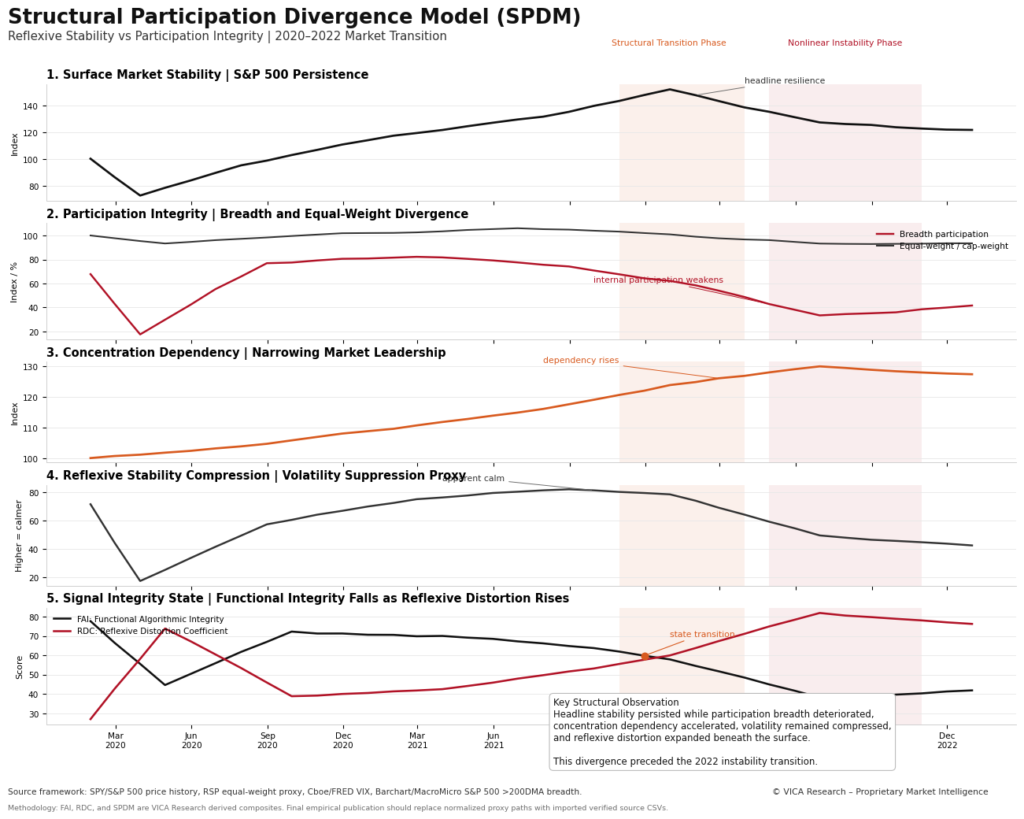
This became increasingly visible prior to the 2022 market reversal as breadth weakened, equal-weight participation deteriorated, and concentration dependency accelerated beneath resilient headline indices.
The deeper issue was not volatility.
The deeper issue was that market structure increasingly optimized for stability appearance rather than structural resilience.
Relative Strength Is No Longer Enough
Traditional market analysis relies heavily on comparative relationships.
Relative strength between sectors, factors, and indices has historically been treated as evidence of institutional conviction and improving participation.
Modern market structure increasingly distorts those signals.
Relative outperformance can now reflect passive inclusion mechanics, liquidity concentration, volatility suppression, and positioning persistence rather than genuine structural expansion.
A market can appear strong while participation weakens internally.
Markets can appear strongest precisely when structural fragility is becoming most dangerous.
CAPM and Legacy Quantitative Systems
CAPM remains one of the most important frameworks in financial history because it formalized the relationship between systematic risk and expected return.
But CAPM depends on assumptions increasingly distorted by modern market structure: informational integrity, rational allocation behavior, and equilibrium-oriented price discovery.
Traditional quantitative systems face the same constraint.
Most algorithmic frameworks were built for environments where volatility retained clearer informational value, correlations remained structurally useful, and price movement more directly reflected independent institutional conviction.
Today, algorithms increasingly react not simply to markets, but to the behavioral outputs of other algorithms operating inside the same liquidity architecture.
Under these conditions, market movement increasingly reflects liquidity mechanics interacting with themselves rather than independent informational behavior.
Functional vs Reflexive Algorithmic States
Algorithmic systems are not inherently flawed.
Quantitative frameworks remain highly valuable when markets retain high informational integrity and decentralized participation.
At VICA Research, we define this condition as:
Functional Algorithmic Integrity (FAI)
FAI measures the degree to which systematic models operate against authentic informational behavior rather than reflexive liquidity distortion.
Under high-FAI conditions:
volatility retains informational value,
correlations remain structurally useful,
and price movement broadly reflects decentralized institutional decision-making.
The challenge emerges when markets transition into reflexive states dominated by passive concentration, derivative amplification, volatility suppression, and self-reinforcing positioning.
At VICA Research, we define this condition as:
Reflexive Distortion Coefficient (RDC)
RDC measures the degree to which market behavior is driven by self-reinforcing liquidity architecture rather than independent informational price discovery.
As RDC rises:
relative strength becomes less reliable,
volatility carries less informational purity,
correlations become increasingly endogenous,
and systematic signals become progressively distorted.
The issue is not that algorithmic systems no longer work.
The issue is that many systems were designed for high-FAI environments and increasingly operate inside rising-RDC market structures.
Liquidity Synchronization and the Collapse of Independent Price Discovery
During high-stress periods, modern markets increasingly behave as synchronized liquidity systems.
Historically, securities responded more independently to company fundamentals, valuation, earnings expectations, and decentralized institutional allocation.
Today, during volatility expansion, correlations increasingly converge regardless of underlying fundamental differences. Securities with materially different economic characteristics frequently move together as components of the same liquidity system.
This occurs because modern markets are increasingly governed by passive index flows, ETF mechanics, volatility-targeting systems, derivative hedging, and systematic de-risking.
Under these conditions, liquidity itself becomes the dominant short-term variable.
During high-RDC environments, markets increasingly behave as unified liquidity systems rather than collections of independently priced productive assets.
This is how informational purity deteriorates as reflexive participation expands.
The 2020–2022 Reflexive Liquidity Regime
The 2020–2022 cycle provides one of the clearest examples of post-linear behavior.
Following the pandemic-era liquidity response, passive inflows accelerated, volatility suppression expanded risk exposure, options activity increased, and mega-cap concentration increasingly dominated index performance.
Headline indices appeared resilient while structural divergences developed underneath the surface:
breadth narrowed,
concentration dependency rose,
equal-weight participation weakened,
and volatility sensitivity quietly compounded.
Markets increasingly optimized around stability persistence itself.
As volatility remained suppressed, systematic exposure expanded. Passive flows reinforced concentration while positioning became increasingly crowded inside the same liquidity architecture.
The result was not equilibrium.
It was reflexive amplification.
When tightening liquidity conditions disrupted volatility suppression in 2022, the reversal became nonlinear. Correlations destabilized, systematic de-risking accelerated, and models built around historical stability assumptions struggled to adapt.
The issue was not simply volatility.
The issue was that market structure had optimized for stability appearance rather than structural resilience.
Structural Participation Divergence Model
2020–2022 Reflexive Liquidity Regime
Chart Component Key Takeaway
Modern market instability increasingly emerges not from visible weakness, but from hidden fragility accumulating beneath prolonged reflexive stability.
The chart should make one point visually unavoidable:
Headline market stability can persist while participation quality deteriorates underneath the surface.
Reflexive Synchronization as a Legacy Market Artifact
Modern reflexive synchronization may ultimately represent a transitional artifact of legacy market structure rather than a permanent feature of optimal financial systems.
As passive concentration and liquidity synchronization expand, markets increasingly compress informational differentiation across assets.
This can temporarily reinforce stability, but it also degrades decentralized price discovery.
The more reflexive and synchronized modern markets become, the less structurally efficient they may become for advanced institutional capital seeking differentiated informational edge.
This is why next-generation institutional frameworks increasingly focus on participation integrity, liquidity architecture, hidden-state divergence, and structural signal quality.
The VMSI Psychology Model
The VMSI Psychology Model was developed around a central premise:
Modern markets must be analyzed through liquidity behavior, participation integrity, volatility structure, concentration dynamics, and behavioral reinforcement.
Traditional frameworks primarily measure price movement.
VMSI attempts to measure the structural quality of participation driving price behavior underneath the surface.
The objective is not merely to identify movement.
The objective is to determine whether market behavior reflects genuine structural expansion or mechanically reinforced stability generated through concentrated liquidity systems.
Structural Participation Integrity Score (SPIS)
To operationalize this framework, VICA Research is introducing the:
Structural Participation Integrity Score (SPIS)
SPIS measures the quality and durability of participation beneath headline index movement.
It answers one institutional question:
Is this market structurally healthy, or merely mechanically stable?
SPIS evaluates:
participation breadth,
equal-weight versus cap-weight divergence,
concentration dependency,
liquidity sensitivity,
volatility compression,
correlation convergence,
passive flow reinforcement,
and informational signal integrity.
High SPIS suggests broader participation, stronger signal integrity, and more durable institutional allocation behavior.
SPIS is not designed to predict short-term direction.
It is designed to measure whether the structure supporting current market behavior is durable or fragile.
Structural Participation Forward Index (SPFI)
To extend the framework beyond current participation quality, VICA Research is also developing the:
Structural Participation Forward Index (SPFI)
SPFI measures whether current participation behavior supports durable future institutional stability or rising reflexive liquidity fragility.
Where SPIS measures current structural participation integrity, SPFI evaluates forward participation durability.
SPFI is designed to identify deterioration before instability becomes visible through traditional indicators.
Live VMSI Monitor
Weekly VMSI readings, SPIS analysis, and structural participation research are available on our Home Page.
Conclusion
Modern financial markets have evolved beyond the assumptions many legacy frameworks were designed to interpret.
Markets increasingly behave as adaptive behavioral liquidity systems shaped by reflexivity, concentration, positioning dynamics, and self-reinforcing participation behavior.
As a result, comparative price movement alone is becoming less reliable as a standalone measure of structural health.
Markets can remain elevated while participation weakens internally. Stability can persist while fragility compounds invisibly. Relative strength can improve while liquidity quality deteriorates.
In modern markets, stability itself increasingly becomes the mechanism through which fragility accumulates.
Post-Linear Market Theory is an attempt to evolve institutional analysis beyond equilibrium-based interpretation toward a more adaptive understanding of reflexive market systems.
The deepest risks and opportunities increasingly emerge not from observable price behavior alone, but from the structural forces shaping participation underneath it.
About the VICA Institutional Market Sentiment Index
The VICA Institutional Market Sentiment Index is VICA Research’s proprietary framework for evaluating structural participation, liquidity behavior, volatility conditions, behavioral persistence, and capital durability beneath headline market movement.
Unlike traditional sentiment models focused primarily on price direction, VMSI emphasizes the integrity, quality, and psychology of participation driving the market itself.
Markets are governed by core capital.Priced by marginal capital.Most investors study price.IC-VMSI studies ownership, capital flows, and institutional force.