Capital began deploying before institutional trust fully returned.
Executive Summary
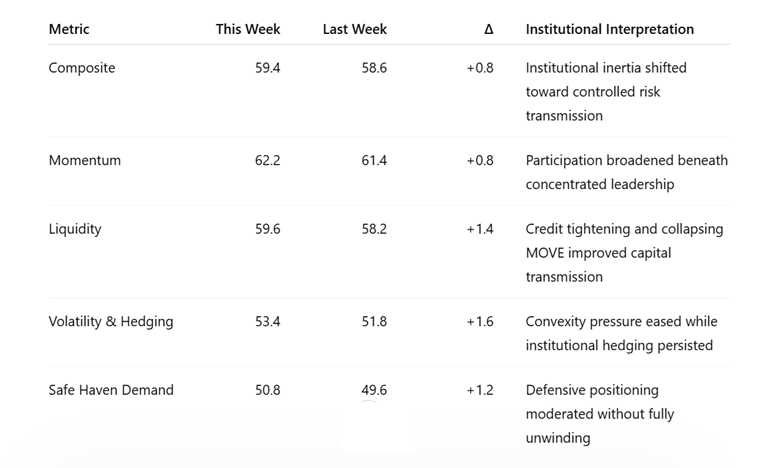
The VMSI increased to 59.4 this week as institutional behavior transitioned away from defensive preservation and toward controlled risk transmission.
That was the real signal.
Most investors focused on higher equity prices. Institutional capital focused on improving transmission quality beneath the rally. Credit spreads tightened, rates volatility collapsed, breadth expanded, and selective global participation strengthened simultaneously.
Institutional inertia moved before institutional trust fully rebuilt.
That distinction defines the current regime.
HY OAS tightened toward approximately 279 bps, IG spreads compressed toward 79 bps, and the MOVE Index collapsed to 67.25, materially reducing balance-sheet stress across the system. At the same time, Russell participation strengthened materially, EEM accelerated sharply, and breadth expanded across intermediate trend structures.
But institutions did not fully remove protection.
CPCI remains elevated near 1.03, VVIX remains near 97, SKEW remains elevated near 138, and gold remains structurally elevated relative to long-term trend. Long-duration Treasuries also continue failing to confirm unrestricted expansion conditions.
The market improved.
Institutional trust improved more slowly.
That asymmetry is where the current institutional edge exists.
Market Structure
The most important structural development this week was not the magnitude of the rally.
It was the expansion in participation beneath concentrated leadership.
The S&P 500 closed at 7,398.93, while the Nasdaq finished nearly 25% above its 200-day trend, confirming continued dominance from growth-sensitive exposure. But unlike prior weeks, the system broadened beneath the surface. Russell participation improved materially, with IWM now more than 25% above its 200-day trend, while breadth expanded toward cyclical confirmation levels.
Approximately 63% of equities now trade above their 50-day averages.
That matters institutionally because broadening participation changes the behavior of institutional balance sheets. Narrow leadership rallies can be absorbed defensively. Broadening participation forces institutions to begin reallocating risk exposure across factor, sector, and duration structures.
But the expansion remains incomplete.
Growth leadership still dominates transmission behavior. VUG remains materially stronger than VTV, confirming that institutions still prefer selective growth deployment over synchronized cyclical expansion.
This is not broad institutional trust. It is selective institutional transmission.
Credit & Liquidity Conditions
Credit and liquidity produced the strongest institutional confirmation signal in the report.
HY spreads tightened from approximately 282 bps to 279 bps, while IG spreads compressed toward 79 bps. That tightening matters because institutional capital rarely accelerates deployment while credit resists the move.
This week, credit stopped resisting.
At the same time, the MOVE Index collapsed sharply toward 67, reducing one of the system’s most important transmission pressures. Lower MOVE readings reduce:
funding instability
duration stress
refinancing sensitivity
cross-asset convexity spillover
This is not simply lower volatility.
It is lower systemic transmission friction.
That distinction matters enormously for institutional capital behavior because balance-sheet deployment is constrained less by equity upside and more by transmission stability across rates, liquidity, and credit markets.
Importantly, the Fed balance sheet remained largely unchanged near $6.71T. The system improved without aggressive liquidity injection.
Liquidity conditions improved because transmission stress declined internally.
That is structurally healthier than policy-driven expansion.
Flow & Allocation Behavior
The flow structure changed materially this week.
Last week, institutions were staging capital.
This week, institutions began selectively transmitting it.
That transition appeared simultaneously across:
emerging-market participation
improving small-cap transmission
tightening credit
declining rates volatility
improving breadth
EEM accelerated sharply relative to intermediate trend structure, while EMB stabilized alongside a softer dollar environment. Capital began rotating outward from concentrated U.S. leadership into broader transmission channels.
But institutions are still protecting against incomplete macro normalization.
Gold remains roughly 39% above its 200-day trend, duration participation remains weak, and institutional index hedging remains elevated.
That combination matters because it reveals how large institutions are behaving beneath price.
Capital is increasing exposure while preserving protection.
That is not euphoric deployment.
It is controlled institutional transmission.
Positioning & Hedging
Positioning behavior continues to reveal the difference between participation and conviction.
CPCE near 0.53 confirms stronger directional participation and increasing speculative appetite. But CPCI near 1.03 confirms institutional index protection remains elevated despite improving market conditions.
That divergence is critical.
Retail and directional exposure accelerated.
Institutional hedging did not materially unwind.
Volatility architecture confirms the same pattern. VIX remained contained near 17, but VVIX remained elevated near 97, while SKEW remained structurally elevated near 138.
Surface volatility compressed.
Institutional protection persisted.
That distinction matters because institutional capital is not behaving as though macro uncertainty has fully normalized. Institutions are increasing deployment only where transmission conditions improved enough to justify selective expansion.
The system reflects improving confidence, not full conviction.
Advanced Signal Layer
The dominant transition this week was the directional movement of institutional inertia.
That is the signal most frameworks still fail to isolate.
Last week’s regime reflected defensive absorption:
Those shifts indicate institutional capital is no longer merely preserving optionality.
It is beginning to reposition balance sheets toward controlled deployment.
But the transition remains incomplete because several major institutional confirmation layers still refuse alignment. Long-duration Treasuries remain structurally weak, geopolitical protection remains embedded, China participation remains incomplete, and institutional hedging remains elevated beneath the surface.
This is not a full expansion regime.
It is the transition phase between stabilization and transmission.
That distinction defines the current institutional positioning edge.
CMX — Convexity Metrics Index
CMX declined to 43.8 / 100, remaining inside a contained convexity regime.
The decline was driven primarily by collapsing MOVE, stable VIX conditions, and suppressed forced-volatility transmission across cross-asset markets. Market movement is no longer triggering destabilizing convexity cascades or forced positioning adjustments.
That is a major institutional development.
Lower convexity pressure allows institutions to increase exposure without destabilizing duration and funding structures simultaneously.
But convexity distrust remains embedded beneath the surface.
VVIX remains elevated near 97, SKEW remains elevated near 138, and institutional protection demand remains active despite improving transmission conditions.
Fragility declined faster than distrust.
That is why CMX improved without fully normalizing.
Pre-Deployment Capital Signals (PDCS)
PDCS increased to 72.4 / 100, entering an incremental deployment regime.
This was one of the most important structural transitions in the report.
Last week, institutional capital was staging.
This week, institutional capital began transmitting risk through the system.
That shift appeared through:
tighter credit spreads
stronger breadth
improved Russell participation
stronger EEM transmission
declining rates volatility
improving liquidity stability
These are not stabilization signals.
They are deployment signals.
But deployment remains controlled because institutions still refuse full trust normalization. Gold remains elevated, duration conviction remains weak, and macro protection remains embedded through index hedging structures.
Capital is moving ahead of conviction.
That is the defining asymmetry inside the current regime.
GFP — Geopolitical Friction Pressure
GFP reads 60.2 / 100, placing the system inside a compression-transition regime.
GFP measures the cumulative effect of unresolved geopolitical pressure on institutional risk behavior over time.
The most important feature of the current regime is not geopolitical panic.
It is institutional geopolitical distrust embedded beneath improving market conditions.
That combination indicates geopolitical friction is still influencing institutional balance-sheet behavior even as markets absorb it more effectively.
At current GFP levels, the system remains inside the nonlinear compression zone where unresolved geopolitical pressure can accumulate beneath surface stability before convex sensitivity accelerates materially.
Markets stabilized faster than geopolitical trust normalized.
That distinction matters.
VMSI Index Insight
Most investors focus on what the market is doing.
Institutions focus on where institutional inertia is moving.
That is the difference.
This week’s signal was not simply higher prices. The signal was simultaneous improvement in:
credit transmission
breadth participation
rates-volatility suppression
liquidity stability
selective global participation
while institutional protection remained embedded beneath the surface.
That combination signals transition.
Not euphoria.
The system is moving away from defensive preservation and toward controlled institutional transmission, but not toward unrestricted expansion.
Institutional capital is repositioning before institutional conviction fully normalizes.
That is the hidden pattern inside this week’s data.
Bottom Line
The VMSI increased to 59.4 because institutional transmission conditions improved materially across credit, liquidity, breadth, and volatility architecture.
CMX declined to 43.8, confirming lower convexity pressure.
PDCS increased to 72.4, confirming selective institutional deployment.
GFP remained elevated at 60.2, confirming unresolved geopolitical compression beneath improving market conditions.
But the most important development was not price appreciation.
It was the directional movement of institutional inertia.
Institutional balance sheets are beginning to transition from preservation toward controlled transmission.
That transition now defines the regime.
About the VICA Institutional Market Sentiment Index (VMSI)
The VICA Institutional Market Sentiment Index (VMSI) measures institutional risk across global markets through momentum, liquidity, volatility, credit, safe-haven demand, convexity dynamics, capital flow inertia, and geopolitical friction.
The model incorporates proprietary frameworks including CMX, PDCS, and GFP to identify state transitions in institutional behavior before they are fully reflected in price.
Markets are analyzed in parts. VMSI™ measures the system.
Disclaimer
This report is for informational purposes only and does not constitute investment advice or a recommendation. Views are based on current data and VICA Research models and are subject to change.
This report and the proprietary VICA Institutional Market Sentiment Index (VMSI) are protected intellectual property. Unauthorized reproduction, redistribution, or use without express permission from VICA Research is prohibited.
VICA Research Capital does not follow headlines. It follows structure.
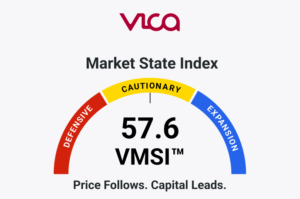
Participation Repaired. Credit Dispersion Persisted. The VMSI™ Composite increased to 57.6, with IC-VMSI™ at 64.9 and the Institutional Capital Migration...
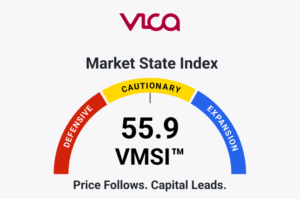
Price Held. Institutional Support Weakened. The VMSI™ Composite declined to 55.9. Headline equity performance remained comparatively resilient, but participation weakened,...