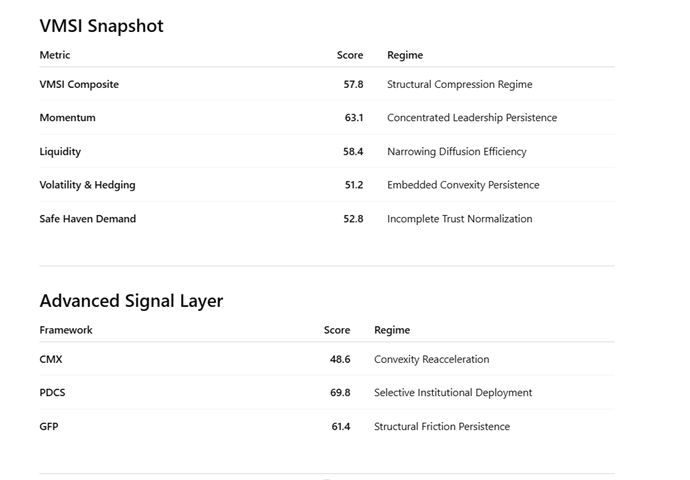
The VMSI declined to 57.8 this week as institutional synchronization quality weakened beneath stable cap-weighted participation.
That was the signal.
Most investors focused on stable index participation. Institutional capital focused on deteriorating propagation quality beneath the surface. Participation dispersion widened, liquidity concentration accelerated, duration confirmation weakened, and convexity persistence remained elevated simultaneously.
Institutional liquidity persisted before institutional trust normalized.
That distinction defined the regime.
The deterioration was measurable. The Participation Dispersion Ratio (PDR) widened approximately 340bps week-over-week, while the Global Elasticity Coefficient (GEC) deteriorated as external participation elasticity weakened approximately 2.4x faster than concentrated domestic persistence.
At the same time:
the Liquidity Diffusion Ratio (LDR) deteriorated for the third consecutive week
the Credit Synchronization Ratio (CSR) flattened beneath stable directional participation
the VVIX/VIX Convexity Persistence Spread remained more than 4.8x above compression equilibrium
The most important structural development this week was not stable headline participation.
It was deteriorating synchronization beneath concentrated leadership persistence.
Participation propagation weakened while concentrated liquidity persistence remained stable. Breadth diffusion decelerated, equal-weight synchronization weakened, and participation redundancy deteriorated simultaneously beneath stable directional participation.
Approximately 63% of equities continue trading above intermediate participation structures, but propagation quality weakened materially underneath.
The deterioration was measurable. The Participation Integrity Coefficient (PIC) weakened for the fourth consecutive week as decentralized participation deteriorated approximately 1.9x faster than concentrated persistence normalized.
At the same time:
the Participation Dispersion Ratio (PDR) continued widening
cyclical participation elasticity softened
cross-factor synchronization weakened
propagation breadth decelerated
simultaneously.
That combination matters because durable institutional expansion normally requires decentralized propagation reinforcement.
Credit and liquidity synchronization weakened this week.
That matters because institutional deployment rarely remains durable when credit acceleration fails confirmation beneath directional participation persistence.
The deterioration was measurable. The Credit Synchronization Ratio (CSR) weakened as spread-compression acceleration decelerated beneath stable concentrated participation.
At the same time:
the Duration Trust Divergence Ratio (DTDR) widened as duration-sensitive participation weakened approximately 1.7x faster than concentrated participation persistence
the Liquidity Diffusion Ratio (LDR) continued deteriorating
cross-asset propagation coherence weakened
simultaneously.
That combination matters because durable institutional expansion normally requires synchronized reinforcement across:
Last week, institutional deployment broadened across participation systems.
This week, deployment re-concentrated into dominant liquidity channels.
The transition was measurable. The Liquidity Diffusion Ratio (LDR) deteriorated for the third consecutive week as concentrated persistence exceeded decentralized propagation capacity by approximately 2.7:1, while the Participation Dispersion Ratio (PDR) widened approximately 340bps week-over-week simultaneously.
At the same time:
the Global Elasticity Coefficient (GEC) deteriorated as external participation elasticity weakened approximately 2.4x faster than domestic concentrated persistence
the Participation Integrity Coefficient (PIC) weakened for the fourth consecutive week
the Credit Synchronization Ratio (CSR) flattened beneath stable directional participation
But deployment quality weakened beneath stable surface participation.
Positioning & Hedging
Positioning behavior continued revealing the divergence between participation and conviction.
Directional participation remained stable, but institutional protection demand failed normalization proportionally with surface participation conditions.
That divergence remained measurable.
The VVIX/VIX Convexity Persistence Spread remained more than 4.8x above historical compression equilibrium, while the Convexity Persistence Ratio (CPR) remained elevated simultaneously beneath stable directional participation.
At the same time:
the Duration Trust Divergence Ratio (DTDR) widened materially
convexity compression failed normalization
institutional asymmetry demand remained elevated
cross-asset hedging persistence remained embedded
simultaneously.
That combination confirmed institutions continued maintaining:
The dominant transition this week was deteriorating institutional synchronization beneath stable directional participation.
That is the signal most frameworks still fail to isolate.
Last week’s regime reflected improving transmission:
tightening credit
expanding breadth
improving participation diffusion
stabilizing volatility transmission
strengthening propagation efficiency
This week, the structure changed.
Participation dispersion widened. Duration confirmation weakened. Convexity persistence remained elevated. Global liquidity elasticity softened. Propagation efficiency deteriorated simultaneously.
The deterioration was measurable. The Force Synchronization Coefficient (FSC) weakened as the Participation Dispersion Ratio (PDR) widened approximately 340bps week-over-week, while the Global Elasticity Coefficient (GEC) deteriorated as external participation elasticity weakened approximately 2.4x faster than concentrated domestic persistence.
At the same time:
the Liquidity Diffusion Ratio (LDR) deteriorated for the third consecutive week
the Duration Trust Divergence Ratio (DTDR) widened materially
the VVIX/VIX Convexity Persistence Spread remained structurally above equilibrium
Institutional capital is no longer broadening transmission at the same rate.
It is selectively concentrating deployment again.
This is not instability.
It is:
structural compression through synchronization decay.
CMX — Convexity Metrics Index
CMX increased to 48.6 / 100, remaining inside a convexity persistence regime.
The increase was driven by embedded asymmetry demand beneath stable participation conditions.
The deterioration was measurable. The Convexity Persistence Ratio (CPR) remained elevated while the VVIX/VIX Convexity Persistence Spread remained more than 4.8x above equilibrium, confirming convexity demand failed normalization despite stable directional participation.
At the same time:
cross-asset hedging persistence remained elevated
duration confirmation weakened
convexity compression failed normalization
institutional asymmetry demand remained embedded
simultaneously.
Fragility stabilized faster than trust normalized.
That distinction continues defining the current convexity regime.
Pre-Deployment Capital Signals (PDCS)
PDCS declined to 69.8 / 100, remaining inside a selective deployment regime.
Last week, institutional deployment broadened across participation systems.
This week, deployment selectively re-concentrated.
The deterioration was measurable. The Propagation Efficiency Differential (PED) weakened as concentrated liquidity persistence increasingly exceeded decentralized propagation capacity, while the Participation Integrity Coefficient (PIC) weakened for the fourth consecutive week as decentralized participation deteriorated approximately 1.9x faster than concentrated persistence normalized.
At the same time:
the Liquidity Diffusion Ratio (LDR) deteriorated approximately 2.7:1 in favor of concentrated persistence over decentralized propagation
the Credit Synchronization Ratio (CSR) weakened beneath stable directional participation
the Global Elasticity Coefficient (GEC) deteriorated alongside weakening external participation elasticity
simultaneously.
These are not instability conditions.
They are selective deployment conditions.
Capital remains active ahead of conviction normalization.
That remains the defining asymmetry inside the current regime.
GFP — Geopolitical Friction Pressure
GFP increased to 61.4 / 100, placing the system inside a structural friction regime.
The most important feature of the current regime is not geopolitical instability.
It is embedded geopolitical distrust beneath stable participation conditions.
The deterioration was measurable. The Global Elasticity Coefficient (GEC) weakened as external participation elasticity deteriorated approximately 2.4x faster than concentrated domestic persistence, confirming external liquidity synchronization weakened beneath stable internal participation conditions.
At the same time:
institutional hedging persistence remained elevated
Institutions focus on how synchronization quality is behaving beneath the market.
That is the difference.
This week’s signal was not stable prices. The signal was simultaneous deterioration in:
participation diffusion
propagation efficiency
duration confirmation
external liquidity elasticity
convexity normalization
while concentrated persistence remained stable beneath the surface.
The deterioration was measurable. The Force Synchronization Coefficient (FSC) weakened as the Participation Dispersion Ratio (PDR) widened approximately 340bps week-over-week, while the Liquidity Diffusion Ratio (LDR) deteriorated for the third consecutive week and the Global Elasticity Coefficient (GEC) weakened as external participation elasticity deteriorated approximately 2.4x faster than concentrated domestic persistence.
More importantly, the system began exhibiting:
asymmetric propagation behavior.
Directional persistence remained stable, but decentralized participation propagation decelerated materially beneath concentrated liquidity reinforcement. Historically, that pattern appears when institutional deployment continues operating ahead of full conviction normalization.
At the same time:
the VVIX/VIX Convexity Persistence Spread remained structurally above equilibrium
the Duration Trust Divergence Ratio (DTDR) continued widening
structural compression through synchronization decay.
Not collapse.
The system remains operationally stable, but force coherence weakened materially beneath headline participation.
Institutional capital continues deploying before institutional conviction fully normalizes.
That is the hidden pattern inside this week’s data.
Bottom Line
The VMSI declined to 57.8 because institutional liquidity continued concentrating while participation synchronization weakened beneath the surface.
That was the real signal.
The deterioration was measurable:
the Participation Dispersion Ratio (PDR) widened approximately 340bps week-over-week
the Liquidity Diffusion Ratio (LDR) deteriorated for the third consecutive week
external participation elasticity weakened approximately 2.4x faster than concentrated domestic persistence
duration-sensitive participation weakened approximately 1.7x faster than concentrated equity persistence
simultaneously.
At the same time, convexity normalization failed. The VVIX/VIX Convexity Persistence Spread remained structurally above equilibrium while credit synchronization flattened beneath stable directional participation.
That combination confirms:
liquidity persisted faster than institutional trust normalized.
But propagation quality, participation breadth, and synchronization coherence weakened materially underneath.
The rally continued.
The system didn’t.
About the VICA Institutional Market Sentiment Index (VMSI)
The VICA Institutional Market Sentiment Index (VMSI) measures institutional risk across global markets through momentum, liquidity, volatility, credit, safe-haven demand, convexity dynamics, capital flow inertia, and geopolitical friction.
The model incorporates proprietary frameworks including CMX, PDCS, and GFP to identify state transitions in institutional behavior before they are fully reflected in price.
VMSI models markets as adaptive institutional systems where directional movement emerges through the synchronization, propagation, and interaction of capital flows, liquidity conditions, participation structures, and convexity positioning.
Markets are analyzed in parts. VMSI™ measures the system.
Disclaimer
This report is for informational purposes only and does not constitute investment advice or a recommendation. Views are based on current data and VICA Research models and are subject to change.
This report and the proprietary VICA Institutional Market Sentiment Index (VMSI) are protected intellectual property. Unauthorized reproduction, redistribution, or use without express permission from VICA Research is prohibited.
VICA Research
Capital does not follow headlines. It follows structure.
Short- and intermediate-horizon participation weakened as volatility and convexity pressure increased. Observable capital deployment strengthened, Treasury cash pressure eased, and...
VICA Partners Research Institutional participation broadened as small caps, equal weight, medium-term breadth, and global equity transmission strengthened while surface...