Institutional synchronization improved this week as participation broadened, credit tightened, volatility compressed, and deployment expanded across multiple market structures. Redundancy quality improved more slowly, with concentration dependency, duration confirmation, and participation integrity still incomplete beneath visible strength.
Live Report: vicapartners.com
VMSI Snapshot Table
Metric
Score
Structural State
VMSI Composite
60.9
Participation broadened beneath concentration.
Momentum
65.8
Breadth improved beneath concentration.
Liquidity
61.1
Liquidity improved faster than confidence.
Volatility & Hedging
52.6
Hedging demand remained elevated.
Safe Haven Demand
52.4
Defensive positioning eased.
Advanced Signal Layer Table
Framework
Score
Structural State
CMX
61
Convexity compression remained incomplete.
PDCS
87
Deployment broadened selectively.
GFP
70
Global propagation stabilized.
SPI
68
Participation broadened beneath concentration.
PLMT
—
Structural compression eased.
Executive Summary
The VMSI increased to 60.9 from 59.1 last week as participation breadth, liquidity conditions, credit transmission, and deployment activity improved across multiple institutional subsystems.
Credit spreads tightened, volatility compressed, small-cap participation strengthened, and external propagation improved as emerging-market and Japanese participation remained constructive. Equity ETF issuance remained positive but slowed, while bond ETF issuance increased, confirming broader allocation activity rather than a pure equity-risk chase.
The key hidden-state transition was not that markets rose. The deeper transition was that synchronization improved across credit, liquidity, volatility, breadth, and deployment while redundancy quality remained incomplete.
Synchronization improved faster than redundancy rebuilt.
Market Structure
Market structure improved as participation expanded beyond the narrowest leadership channels and internal breadth conditions strengthened relative to prior stabilization phases.
The Russell 2000 strengthened, equal-weight participation improved, value participation remained constructive, and emerging-market participation expanded. SPI rose to 68, confirming that participation quality improved across more than one market layer.
However, concentration dependency remained embedded beneath the improvement. Growth leadership, cap-weight dominance, and incomplete long-duration breadth still limited the quality of the advance.
Participation broadened without fully reducing concentration dependency.
Credit & Liquidity Conditions
Credit and liquidity conditions improved as institutional capital continued moving into risk while funding stress remained contained.
High-yield OAS tightened to 2.72%, while investment-grade OAS tightened to 0.73%. Bond ETF issuance increased, credit ETFs stabilized, and liquidity diffusion improved relative to prior weeks. These conditions confirmed that credit markets were not validating recession stress.
However, duration-sensitive structures did not fully confirm the improvement. TLT, EDV, and ZROZ improved tactically but remained below longer-term confirmation levels, showing that institutional trust did not normalize as quickly as credit appetite.
Credit improved faster than duration confidence.
Positioning & Convexity
Positioning and convexity conditions improved as volatility compressed across equity and rate markets.
VIX declined to 15.32, VVIX fell toward 86, MOVE compressed near 70, and equity put/call behavior became more risk-on. These readings confirmed that realized volatility and volatility-of-volatility pressure eased materially.
However, SKEW remained elevated near 144 and index protection demand did not disappear. Institutions reduced hedging pressure, but they did not abandon asymmetric protection beneath visible calm.
Volatility compressed faster than protection demand normalized.
Flow & Allocation Behavior
Flow and allocation behavior improved as deployment broadened across equity, credit, bond, and external participation channels.
Equity ETF issuance remained positive but slowed from the prior week, while bond ETF issuance increased. Value, small caps, emerging markets, and credit all participated, confirming that capital allocation broadened beyond the narrowest growth leadership structure.
The hidden signal was not unrestricted risk appetite. The signal was broader deployment with selectivity still intact.
Deployment broadened without fully restoring redundancy quality.
Structural Participation Integrity (SPI)
Structural Participation Integrity improved as breadth, equal-weight participation, small-cap participation, and external participation strengthened.
New highs expanded, breadth improved, and participation moved beyond the most concentrated leadership channels. SPI at 68 confirmed a meaningful upgrade from stabilization toward broader institutional participation.
However, participation integrity remained incomplete. Concentration dependency, uneven long-duration breadth, and persistent cap-weight leadership prevented a full-system participation confirmation.
Participation improved faster than resilience rebuilt.
Global Propagation Conditions
Global propagation improved as external participation strengthened across several major transmission channels.
EEM showed strong participation, Japan remained constructive, and DXY remained stable enough to avoid becoming a major external liquidity headwind. These signals confirmed improving global transmission quality relative to prior weeks.
However, China remained the primary fracture point. FXI continued to lag broader global participation, keeping global synchronization uneven despite improvement elsewhere.
Global propagation improved without achieving full synchronization.
Advanced Signal Layer
The advanced signal layer confirmed that the week’s dominant transition was synchronization improvement beneath incomplete redundancy.
CMX improved to 61, PDCS strengthened to 87, GFP improved to 70, and SPI reached 68. Together, those readings confirmed broader deployment, reduced convexity pressure, improved global propagation, and stronger participation quality.
However, the advanced layer also confirmed that the system did not fully normalize. Convexity compression remained incomplete, deployment remained selective, global propagation remained uneven, and participation integrity still lagged visible market strength.
Synchronization improved while redundancy remained incomplete.
This remains a Selective Synchronization Expansion regime.
CMX — Convexity Metrics Index
CMX increased to 61 as volatility and rate-risk compression improved beneath expanding participation.
VIX, VVIX, and MOVE all improved materially relative to prior deterioration phases. Dealer positioning remained consistent with volatility suppression, while lower realized volatility reinforced visible market stability.
However, elevated SKEW and remaining index protection showed that institutional hedging behavior did not fully normalize. Calm conditions reduced convexity pressure, but did not eliminate structural protection demand.
Convexity compression remained incomplete.
PDCS — Pre-Deployment Capital Signals
PDCS increased to 87, reflecting one of the strongest deployment readings of the current cycle.
Credit tightened, liquidity improved, participation broadened, ETF allocation remained constructive, and economic data showed support from durable goods and manufacturing activity. These signals confirmed that institutional capital was increasingly willing to deploy across more than one risk channel.
However, duration confirmation, concentration dependency, and incomplete redundancy limited full synchronization quality. Capital deployed more broadly, but the system still required confirmation from deeper trust channels.
Deployment broadened selectively.
GFP — Geopolitical Friction Pressure
GFP improved to 70 as global propagation stabilized beneath stronger external participation.
Emerging-market participation strengthened, Japan remained constructive, and dollar conditions remained stable. These developments improved global transmission quality relative to prior weeks.
However, China remained structurally weak and broader propagation quality remained uneven. Global stabilization improved, but it did not become universal.
Global propagation stabilized.
Post-Linear Market Theory (PLMT)
One of the framework’s core principles became clearer this week.
Institutional systems can synchronize before redundancy fully rebuilds. Credit, liquidity, volatility, participation, deployment, and global propagation improved together, creating a more constructive operating environment than the prior stabilization regime.
However, the system remained dependent on concentrated leadership, incomplete duration confirmation, residual hedging demand, and uneven external propagation. Those conditions show that visible strength and structural resilience are not the same state.
Participation expanded faster than redundancy rebuilt.
Final Institutional Assessment
Institutional synchronization improved this week. Participation broadened, credit tightened, liquidity conditions improved, volatility compressed, and deployment expanded across more market channels.
However, structural normalization remained incomplete. Concentration dependency, incomplete duration confirmation, residual hedging demand, uneven China participation, and incomplete participation integrity remained embedded beneath visible strength.
Current conditions are best classified as a Selective Synchronization Expansion regime rather than a fully normalized expansion regime.
Synchronization Improved. Redundancy Lagged.
About the VICA Institutional Market Sentiment Index (VMSI)
The VICA Institutional Market Sentiment Index (VMSI) measures institutional risk across global markets through momentum, liquidity, volatility, credit, safe-haven demand, convexity dynamics, capital flow inertia, and geopolitical friction.
The model incorporates proprietary frameworks including CMX, PDCS, and GFP to identify state transitions in institutional behavior before they are fully reflected in price.
VMSI models markets as adaptive institutional systems where directional movement emerges through the synchronization, propagation, and interaction of capital flows, liquidity conditions, participation structures, and convexity positioning.
Unlike traditional sentiment frameworks, VMSI is engineered to identify hidden-state structural changes beneath headline market participation, including liquidity diffusion deterioration, convexity persistence, concentration dependency, propagation instability, and incomplete synchronization conditions.
Markets are analyzed in parts. VMSI™ measures the system.
Disclaimer
This report and the proprietary VICA Market Sentiment Index (VMSI) are confidential works of authorship protected by intellectual property laws. Unauthorized reproduction, copying, redistribution, or use without express permission from VICA Research is strictly prohibited and monitored.
This report is for informational purposes only and does not constitute investment advice or a recommendation. Views are based on current data and VICA Research models and are subject to change.
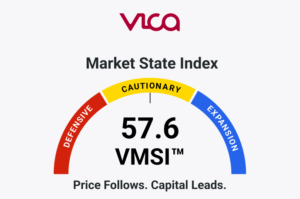
Participation Repaired. Credit Dispersion Persisted. The VMSI™ Composite increased to 57.6, with IC-VMSI™ at 64.9 and the Institutional Capital Migration...
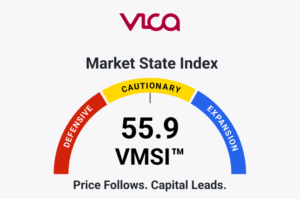
Price Held. Institutional Support Weakened. The VMSI™ Composite declined to 55.9. Headline equity performance remained comparatively resilient, but participation weakened,...